


The right solutions for industrial glass painting: how to achieve trendy aesthetic finishes using Contecolor paints.
The importance of choosing the most suitable paint and the correct technical solutions to achieve impactful, realistic, and durable aesthetic finishes on glass.
To achieve the best results in terms of application and reliability, it is essential to pay maximum attention to glass surface preparation.
For fashionable and distinctive aesthetic finishes, selecting the right paint is fundamental, but even more critical is ensuring the perfect cleaning of the surface before any other process begin
Glass flame treatment
To prepare the glass surface, ensuring perfect adhesion and long-lasting paint durability, the first step is the “flame treatment”, a process that makes the material more receptive while eliminating any impurities.
Adhesion promoter
A further chemical aid is the “adhesion promoter”, an additive included in the paint mix that guarantees surface resistance and adhesion.
It is also essential to note that during glass painting, curing the paint is necessary for cross-linking, regardless of the type (solvent-based or water-based), typically ranging from 160°C to 180°C depending on the shape and size of the substrate.
Colors and finishes: the role of distinctive aesthetic finishes in glass customization
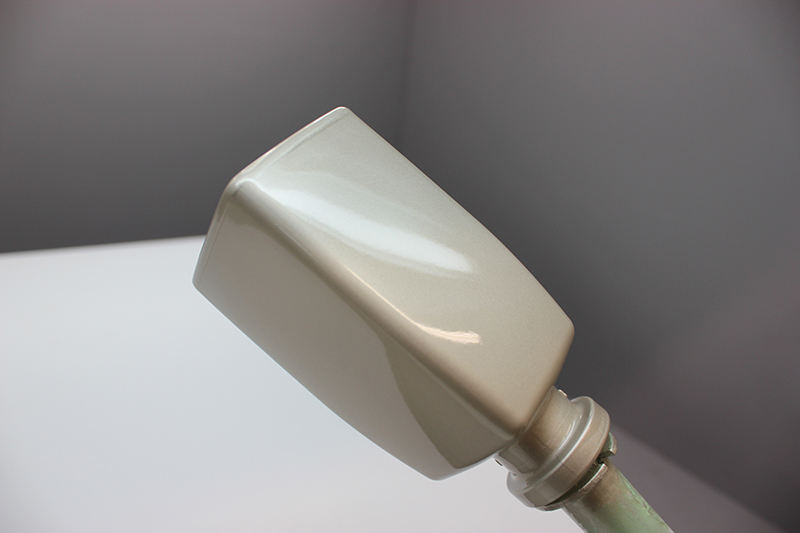
In industrial glass painting, finishes play a key role in the product’s aesthetic creation.
Knowing how to customize with the right materials and processes and respecting the stylist’s aesthetic choices is fundamental: the applied paint is the “outfit” of the glass, which must present the product through distinctive aesthetic finishes.
These finishes are crucial for personalizing transparent surfaces, directly influencing the final aesthetic result.
Developed through advanced study, these solutions introduce visual and tactile variations.
“Production departments, from small local companies to large multinationals, increasingly require glass customization through trend-driven aesthetic finishes (copper effect, Corten effect, etc.) achieved through painting processes. Glass is a highly versatile material widely used for high-level customization projects. Therefore, it is essential for Contecolor to offer custom paints and aesthetic solutions tailored to client specifications, meeting market demands,” states Tiziano Cocco, Contecolor sales engineer.
Satin finish
The satin or matte finish in traditional glass processing can be achieved through acid etching or sandblasting.
Satin effects through painting offer an eco-friendly customization solution using specially formulated water-based paints. Contecolor’s flexibility in custom production of matte paints ensures the ability to achieve and replicate all requested opacity levels.
Metallic finish
How can glass appear as a different material? By using metallic finishes, designed to simulate metal colors from gold to aluminum, and through paints that enhance and refine the item.
Transparent coloring
An additional aesthetic advantage for glass products is transparent coloring, achieved by pigmenting transparent finishes. This allows companies to mix pigments in precise percentages to create their own custom color.
Pearl effect
Finally, the use of pearl finishes, containing mica, creates a distinctive aesthetic that alters color perception depending on angle and light refraction.
“The combination of technical expertise and creativity opens the door to innovative, personalized projects. We know how to advise on the right paint to achieve any effect. By combining our know-how in custom paint production with experience in reproducing distinctive aesthetic finishes on glass, we can support our clients through every step of the finishing process,” concludes Cocco.


